
How Do I Obtain a Barcode for My Product?
May 21, 2025
What Is the Difference Between a UPC and EAN?
August 4, 2025
You have probably scanned a simple one‑line barcode UPC at the grocery store. Yet, the small, square patterns on a concert ticket or medicine vial may look alien. These squares are 2D barcodes. They store data in both directions—left‑to‑right and top‑to‑bottom—so a single symbol can hold hundreds of characters rather than a couple of dozen. That extra capacity allows you to embed a serial number, lot code, and expiration date on one label, while still leaving room for a website link. Because 2D codes include built‑in error‑correction math, they stay readable even when scratched or printed on curved plastic. The result is faster scans, richer data capture, and fewer labeling headaches for everyone from pharmacists to aerospace logisticians.
What Is a 2D Barcode?
A 2D barcode is a geometric grid of light and dark modules that represents digital information in two planes. A camera-based scanner photographs the whole matrix, and then software interprets the pattern and decodes the payload—often hundreds of alphanumeric characters—in under a second. Unlike a one‑dimensional stripe pattern, a 2D symbol is self‑contained; it does not have to call a database for every detail. One scan can reveal a product’s serial number, manufacturer ID, and packaging date simultaneously, eliminating the need for manual data entry and database look-ups.
Structure and Error Correction
Every 2D symbology relies on three design pillars. Modules hold the binary data. Finder patterns, such as the three large squares in a QR code, help the barcode scanner locate and orient the symbol. Reed–Solomon error–correction blocks allow the software to rebuild the message if up to 30 percent of the image is missing. Thanks to that redundancy, engineers can print codes at very small x‑dimensions, mount them on metal, or etch them onto glass without losing reliability.
1D Barcodes vs 2D Barcodes: Capacity, Footprint, and Durability
A conventional UPC stores roughly 20 digits—plenty for a price look‑up, but insufficient for traceability. A Data Matrix the same size can encode several hundred characters, giving supply‑chain teams the freedom to embed multiple data points in one label. The built‑in error correction also enables tighter printing tolerances and better survival in harsh environments; a 2D label can still scan after a high‑temperature wash or a brush with a conveyor guard.
Regulatory Frameworks Driving Adoption
Governments are mandating richer, on‑package data. The U.S. Food and Drug Administration’s Unique Device Identification rule assigns Data Matrix codes to medical devices, as does the European Union’s MDR regulation. Retailers are preparing for GS1’s Sunrise 2027 initiative, which will require 2D symbols at the point of sale. Companies that adopt the technology early can avoid last‑minute relabeling campaigns and the risk of non‑compliance fines.
Cost‑Benefit Snapshot
Initial investments include upgraded label design software, an inline verifier, and possible imaging scanners for legacy workstations. Against those costs, firms save on label stock by combining several 1D stickers into one 2D code, reducing labor minutes per transaction, and cut the scope of recalls. A 2024 study by Zebra Technologies found that warehouses transitioning to 2D barcodes shaved eleven seconds from each receiving cycle, translating into six-figure annual savings for mid‑size facilities.
Major Types of 2D Barcode Symbologies and Their Strengths
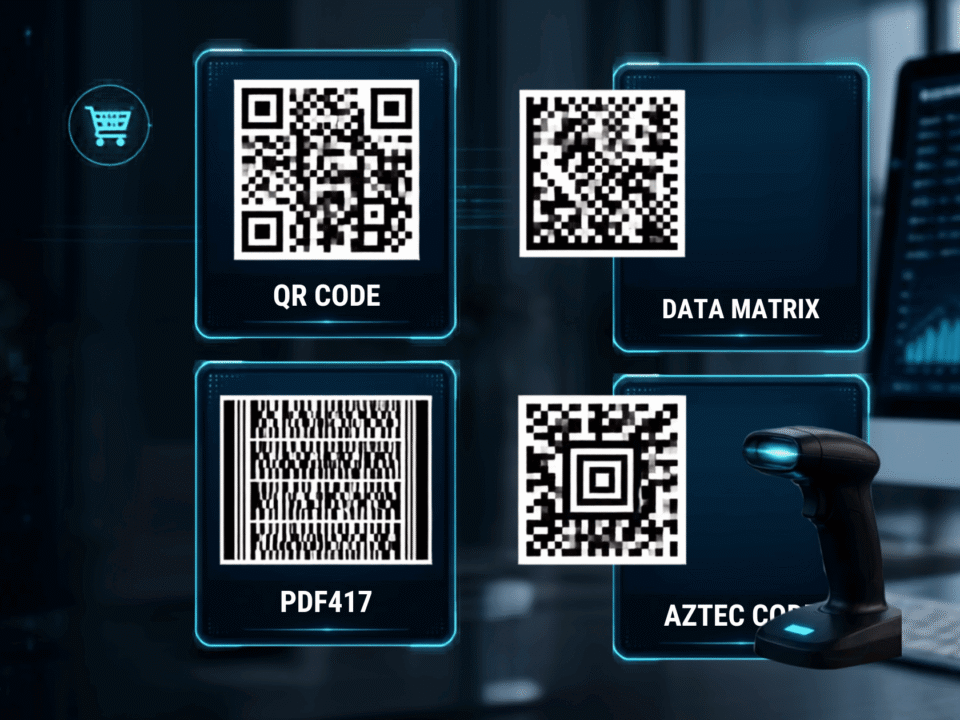
QR Code – Ideal for consumer engagement, mobile payment, and loyalty programs because any smartphone can read it. Data Matrix – Favored in electronics, pharmaceuticals, and aerospace, where space is tight but data density requirements are high. PDF417 – Used on shipping labels, driver’s licenses, and boarding passes; its stacked rows offer ample capacity while remaining human‑readable. Aztec Code – Performs well on tickets and government IDs because it remains legible at low resolution and without a quiet zone. Choosing the proper format depends on available label area, required data capacity, and the imaging hardware already in service.
Real‑Time Data Integration
Most industrial imagers manufactured in the last decade decode both stripe and matrix symbols. Migration often involves a firmware update rather than a hardware swap. Once captured, barcode data flows over Wi‑Fi, Bluetooth, or Ethernet into warehouse‑management or ERP systems, updating stock counts and genealogy records immediately. During a recall drill, quality teams can filter for a specific lot in minutes, rather than scouring spreadsheets for hours.
Implementation Roadmap
- Label audit. Identify which data elements must accompany the product and which can reside in the database.
- Symbology and substrate selection. Match the code type and label material to environmental stresses such as heat, solvents, or UV light.
- Print‑quality verification. Install an inline verifier and enforce ISO grading before cartons leave the plant.
- Change‑management training. Walk operators through the best scan angles, then validate that downstream software accepts the richer data set.
Pilot programs on outer cases build confidence before extending 2D labeling to individual units.
Clearing Up Misconceptions
Many managers believe that 2D labels cost more; however, consolidating multiple 1D stickers into a single symbol typically lowers overall spend on stock and labor. Others assume legacy laser scanners cannot handle matrix codes; in reality, most modern hybrids decode both formats. A final myth claims every sector uses its own proprietary standard. Global bodies, such as GS1, have harmonized application identifiers, allowing a Data Matrix and a QR Code to store identical fields in an open, interoperable structure.
Benefits Recap
- Complete data in one scan streamlines workflows and reduces transcription errors.
- Smaller footprints fit on microchips, syringes, or jewelry tags without adding bulk.
- Built-in error correction keeps the symbol readable after abrasion or exposure to heat.
- Regulatory compliance simplifies audits and reduces the scope of recalls.
The Main Point
2D barcodes merge the compact form of a graphic icon with the data depth of a small database. By understanding their structure, regulatory landscape, and cost profile, supply‑chain leaders can roll out the technology with confidence and capture measurable gains in speed, accuracy, and visibility.
Questions about Implementing Barcodes in Your Supply Chain?
Visit bar‑code.com to find out how we can help you find the right barcoding system for your product and industry. Our experts ensure that your symbols meet GS1 standards. Our specialists will guide you to ensure every scan delivers the traceability your supply chain demands.
Email: 247@bar-code.com