
What Are 2D Barcodes? A Practical Guide for Faster, Smarter Supply Chains
August 4, 2025
FNSKU vs UPC vs ASIN on Amazon
September 3, 2025
In 1974, a hand-held scanner beeped in an Ohio supermarket as the first retail item was logged using the Universal Product Code, also known as the familiar UPC.
Nearly half a century later, that 12-digit symbol still rules North American checkouts, yet its 13-digit cousin, the EAN, dominates shelves across Europe, Asia, and Australia, for retailers and manufacturers, using the wrong code can mean delays at customs or a rejected shipment at the warehouse gate.
Although UPC and EAN look almost identical to the untrained eye, the extra digit matters. Understanding those nuances saves label reprints and data headaches.
UPC and EAN at a Glance
A UPC-A is a one-dimensional barcode that encodes a 12-digit Global Trade Item Number (GTIN-12) and is optimized for fast scanning in the United States and Canada. An EAN-13—technically a GTIN-13—adds one additional digit, usually a country prefix, making the symbol instantly recognizable to point-of-sale systems worldwide.
Current scanners read both, but older checkout lanes may still assume 12 digits unless reconfigured. From a design standpoint, both symbols use identical bar-and-space patterns; the EAN simply shifts the readable numbers slightly left to fit the extra character. The upshot is that upgrading from UPC to EAN rarely requires new printers—just the correct 13-digit numbers.
Historical Roots and Standard Bodies
The UPC emerged from the Uniform Code Council (UCC) in the early 1970s to modernize grocery checkout lines. European retailers soon required a globally unique alternative and, in 1977, extended the UPC with a leading digit to create the European Article Number, or EAN.
Today, the nonprofit GS1 governs both formats through a single set of rules, treating UPC and EAN as siblings within the larger GTIN family. That consolidation means one GS1 company prefix can legally generate either code, eliminating the need to maintain separate number banks.
Technical Differences
Before going too deep into region-by-region policies, let’s take a look at the technical differences between the two examples.
Digit count
- UPC-A: 12 numeric characters (GTIN-12)
- EAN-13: 13 numeric characters (GTIN-13)
Because many EANs simply add a leading zero to an existing UPC, converting between the two often involves padding or stripping that zero in the database rather than re-encoding product details.
The spare digit also carries country prefix information—for example, prefixes 400–440 indicate Germany, while 890 indicates India.
Modern imagers typically decode both symbols by default; however, legacy laser scanners manufactured before the early 2000s may disable EAN reading to conserve memory. Checking firmware settings before shipping mixed inventory helps avoid unexpected no-scan issues on the retail floor.
Geographic Usage and Market Considerations
North American retailers such as Walmart and Target still require the GTIN-12 format at their point-of-sale systems. Outside North America, most brick-and-mortar stores expect EAN-13 because its prefix simplifies international data aggregation.
Online marketplaces like Amazon accept both but often convert UPC submissions to 13-digit equivalents behind the scenes by adding a leading zero, meaning sellers who plan to expand globally may skip a relabeling step by starting with EANs from day one. Even so, the best practice is to confirm code preferences with each major trading partner before the first shipment leaves the dock.
Practical Implications for Retailers and Manufacturers
Inventory and ERP systems usually store each product as a 14-digit GTIN. This includes adding two zeros to UPCs and one zero to EANs, allowing both to fit into one field.
Problems arise when staff mistakenly create duplicate SKUs by treating UPCs and EANs as separate items. To avoid these duplicates, a business should establish data mapping and validation regulations. Packaging teams also need to think about label size. For example, small items like cosmetics may require smaller barcodes (UPC-E or EAN-8), which need GS1 approval.
While the cost of GS1 registration is the same for all formats, non-compliant labels can lead to heavy fines from retailers, far exceeding the initial registration costs. Likewise, a barcode that doesn’t scan can slow down checkout and might even make customers suspect the item is fake or of low quality.
Beyond Cartons: GTIN-14 and Case Codes
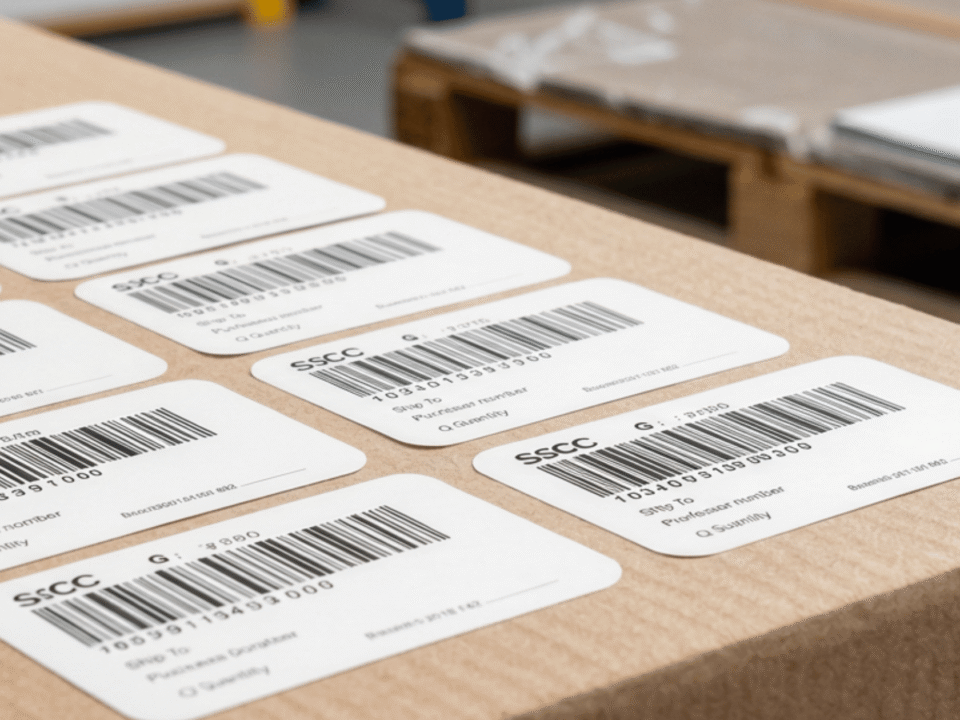
While UPC and EAN identify individual retail units, bulk shippers often apply a GTIN-14 on cartons or pallets. That 14-digit code builds on the same numeric base as the item-level UPC/EAN and adds a logistics marker to show pack configuration.
Converting UPC to EAN in Three Steps
- Add a leading zero to the 12-digit UPC number.
- Re-calculate the new 13-digit EAN check digit—GS1’s free web tool completes this automatically.
- Update your ERP master data and regenerate the barcode image at 100 % magnification to maintain print quality.
Because the underlying company prefix and item reference stay intact, the packaging artwork may remain the same except for the extra numeral beneath the bars.
Common Myths
Sellers often worry that a UPC won’t scan in other countries. However, most European checkout systems can read both UPCs and local codes. The acceptance of these codes depends on local rules, not technology.
Others assume EAN is mandatory outside the United States, but Canadian chains routinely accept UPC. A final myth says businesses need separate prefixes for each format, but in reality, a single GS1 license covers both.
Final Thoughts
UPC and EAN share the same GS1 DNA but differ in digit length, country prefix, and established retail practices. Choosing the correct symbol—and mapping it correctly in master data—keeps products moving quickly through domestically and across international borders.
Get GS1-Approved Barcodes Today
AccuGraphiX— a GS1 US Solution Partner—licenses genuine GTINs and prints or verifies UPC/EAN labels with same-day turnaround for runs starting at 500 units. Our team also supplies Amazon-ready artwork and GS1-128 logistics labels to ensure every code scans flawlessly. Call (714) 632-9000 to speak with a barcode specialist and start your order today, or email us at 247@bar-code.com.